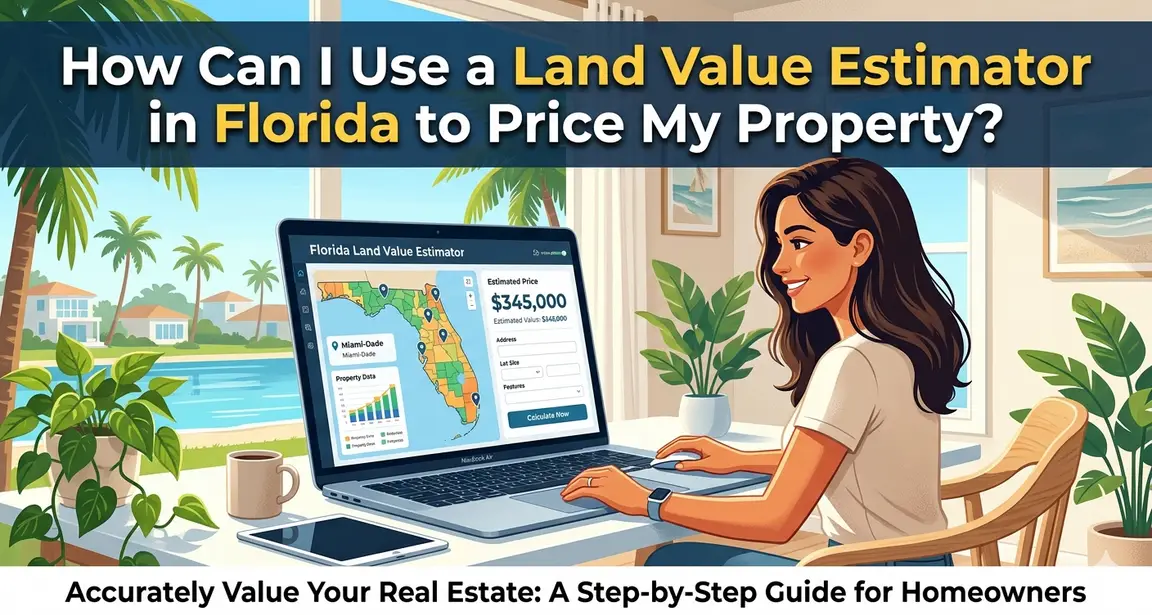
If you want to price your land with more confidence, a Land Value Estimator in Florida can give you a strong starting point. It helps you review local pricing trends, compare nearby parcels, and decide whether you should list higher, lower, or closer to the current market value. Many sellers begin with a free land value estimator in Florida, a how much is my land worth calculator, or a basic search tool before they speak with an agent, land investor, or appraiser.
That is smart, but the best pricing decisions happen when you combine the estimate with county records, sold comps, zoning details, and the real cost a buyer will face after closing. That extra layer matters because land buyers do not just value acreage. They value usability, access, timing, and risk.
What Is a Land Value Estimator in Florida and How Does It Work?
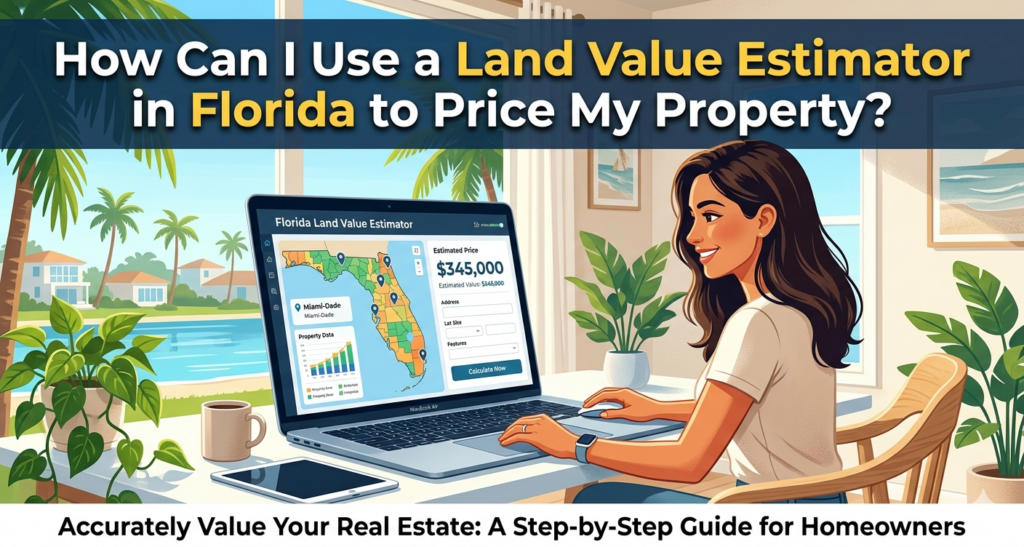
A Land Value Estimator in Florida is an online tool that gives you an estimated value for vacant land based on parcel details, nearby sales, and market conditions. It is useful for setting expectations, but it works best as a starting point instead of a final price decision.
In simple terms, the tool tries to match your property with similar land that has sold or is currently listed nearby. It may look at:
- Acreage
- Location
- Zoning
- Access
- Utilities
- Nearby sales activity
- Property history
Some sellers search for a land value in Florida by address when they want a fast answer. Both can help, but parcel-based data is usually more reliable than a broad address search, especially for vacant land. Here is the practical takeaway: the estimate is useful because it gives you a pricing range, not because it gives you a perfect number.
Real Example: when evaluating a 2-acre parcel in Florida, a land value estimator provided an estimate of $150,000, based on recent sales and zoning status. After verifying these details with county records, the seller adjusted the listing price to $155,000 to reflect the parcel’s strategic location. The sale closed shortly after, at 5% above the estimated value, highlighting the tool’s reliability when paired with expert research and analysis.”
How Accurate Is a Land Value Estimator in Florida for Pricing Property?
It may not fully capture unusual property features. It performs best when your lot is similar to recently sold nearby parcels.
Accuracy tends to improve when:
- Your land is in an active market
- There are enough recent comparable sales
- The lot has normal access and standard zoning
- The parcel has clear public data
Accuracy tends to drop when:
- The land is landlocked
- Wetlands limit buildability
- The parcel has easements
- Utilities are far away
- The property is unusual for the area
This is where sellers often get confused. If the tool says your lot is worth $85,000, that does not mean buyers will line up at $85,000. It means the property may fall within that range if the lot is buildable, accessible, and more attractive than competing listings.
How Much Is My Land Worth in Today’s Market?
Your land is worth what a qualified buyer is willing to pay today, based on recent comps, parcel usability, and local demand. Market value is not the same as your tax bill, your neighbor’s asking price, or your personal goal.
To estimate the current market value, ask:
- What did similar lots sell for recently?
- How long did those listings stay on the market?
- Are builders, cash buyers, or end users active in the area?
- Does my parcel have advantages or limitations?
A lot with paved road access and nearby utilities may sell faster and for more than a larger parcel with legal or site issues. That is why pricing land is not just about size. It is about what a buyer can do with the property after purchase.
Can You Estimate Land Value by Address or Parcel Number?
Yes, you can estimate land value by address or parcel number, but the parcel number usually gives you a cleaner result. It helps you confirm that you are looking at the exact property and not a nearby lot with different characteristics.
If you are using a land value estimator in Florida by address, check the result against county records before you trust it. Verify these details:
- Correct parcel boundaries
- Correct lot size
- Correct zoning
- Correct road access
- Correct flood zone status
Parcel-based pricing is usually more dependable because vacant land often has limited street-address data.
What Information Do You Need to Get a More Accurate Estimate?
You need complete and correct parcel details to get a more accurate estimate. The better your data, the stronger your pricing strategy.
Start with this checklist:
- Parcel ID
- Acreage
- Zoning
- Road frontage
- Utility access
- Flood zone information
- Wetlands or drainage notes
- HOA or deed restrictions
- Recent tax record
- Survey, if available
If you are valuing agricultural acreage, you may also look for a farm land value in Florida. Still, even then, raw online estimates should be checked against soil quality, water access, lease potential, and the local market for similar farm parcels.
Can a Land Value Estimator in Florida Help You Set the Right Asking Price?
Yes, a land value in Florida can help you set the right asking price by creating a range rather than relying on a single fixed number. It is most useful when paired with solid comps and a clear sales goal.
A smart pricing plan usually includes three numbers:
- Minimum acceptable price
- Target market price
- Stretch price with room to negotiate
For Example, if your estimate suggests $90,000 and comparable sales support $86,000 to $92,000, you might:
- Price near $87,900 for a faster sale
- Price near $91,900 for a normal market test
- Avoid pricing at $109,000 unless the parcel has premium features
This kind of pricing protects you from two common mistakes: underpricing land that should sell well, and overpricing land that gets ignored.
Should You Use a Land Value Estimator in Florida Before Selling Land?
It also helps you compare your options when deciding between listing traditionally and taking a direct offer.
Many owners who search for ‘sell my land fast in Florida are not just looking for speed. They are trying to understand the trade-off between convenience and price. That is where an estimator becomes valuable. It gives you a reference point before you talk to buyers, investors, or companies, advertising that we buy land fast in Florida.
It also helps if you are comparing:
- A full-market listing
- A discounted cash offer
- A direct-to-investor sale
- An as-is sale with minimal prep
If you want to sell your land fast in Florida, a realistic asking price is usually more important than an aggressive one.
How Do Comparable Sales Affect the Final Price?
Comparable sales affect the final price by showing what real buyers recently paid for similar land. They are one of the strongest signals for setting a listing price or reviewing an offer.
Strong comps should be:
- Recent
- Nearby
- Similar in size
- Similar in zoning
- Similar in access and utility availability
Do not compare your lot to the highest asking price in town. Compare it to sold properties with similar conditions. Active listings show competition. Sold comps show what the market actually accepted.
Is Tax-Assessed Value the Same as Market Value?
No, tax-assessed value is not the same as market value. Tax value is used for property tax purposes, while market value reflects what a buyer may actually pay right now. This matters because sellers often assume the county number is the selling number. It is not. A parcel may sell above or below its assessed value depending on:
- Local demand
- Site conditions
- Buildability
- Buyer financing
- Timing
Use tax records as one data point, not your main pricing strategy.
Do Zoning Rules Change What Buyers Will Pay?
Yes, zoning rules directly affect what buyers will pay, as they control use, density, and development potential. A property with better use options usually commands stronger pricing.
Zoning can influence:
- Whether a home can be built
- Whether the lot can be split
- Whether commercial use is allowed
- Whether manufactured homes are allowed
- How much permitting work will a buyer face
I often describe this as paper-friction risk. That means the hidden drag caused by rules, approvals, setbacks, and restrictions. Buyers factor that risk into their offers even when sellers do not.
How Can a Land Value Estimator in Florida Help You Compare Local Market Prices?
A land value estimator in Florida helps you compare local market prices by showing where your property sits against nearby listings and recent sales. It is especially useful for spotting whether your lot should be priced below, within, or above the local range. Zip codes are too broad to capture all the factors that affect a specific lot.
To compare local prices well, look at:
- Price per lot, not just price per acre
- Utility-ready lots vs raw land
- Corner lots vs interior lots
- Rural land vs growth-corridor land
- Buildable lots vs constrained lots
That is how you move from a rough estimate to a usable pricing decision.
What Factors Does a Land Value Estimator in Florida Consider?
A land value in Florida considers location, size, land use, and comparable sales, but the best pricing decisions also account for buyer cost after closing. That is what separates a generic estimate from a real-world sale strategy.
The most important factors usually include:
- County and neighborhood demand
- Parcel size and shape
- Zoning and permitted use
- Road access and frontage
- Utility availability
- Flood zone or wetland concerns
- Nearby development activity
This is where I use the phrase dirt-to-doorstep cost. Buyers do not only care what the land costs today. They care what it will cost to reach the point where they can actually use it. If septic, clearing, drainage work, or driveway installation will be expensive, the offer usually drops.
How Do Flood Zones, Wetlands, or Easements Affect Land Value?
Flood zones, wetlands, and easements can reduce land value by affecting usability, financing, development costs, and buyer confidence. Sometimes the impact is small. Sometimes it changes the entire deal.
These issues can:
- Reduce the buildable area
- Increase site-prep costs
- Slow down permits
- Trigger engineering expenses
- Limit structure placement
A five-acre parcel with only one buildable acre is not priced as if it were five fully usable acres. That is why surface acreage and usable acreage are not always the same thing.
Should You Trust an Online Estimate or Pay for an Appraisal?
Trust an online estimate for research and early pricing, but pay for an appraisal when the parcel is high value, unusual, or part of a legal or lending decision. Both tools have value. They serve different purposes.
Use an estimator when you want to:
- Check the value quickly
- Compare pricing options
- Review an incoming offer
- Decide whether to list now or later
Use an appraisal when you need:
- A formal valuation
- Support for financing
- Estate or legal documentation
- A stronger opinion on a unique parcel
A free land-value estimator is excellent for early decision-making. A formal appraisal is better when precision matters more than convenience.
What Is the Best Asking Price if You Want to Sell Quickly?
The best asking price for a quick sale is usually slightly above the strongest market-supported number, not far above it. Buyers move faster when the price feels fair from the start. If your goal is speed, think about your likely buyer:
- Investor
- Builder
- Neighbor
- End user
- Cash buyer
If you are comparing direct-offer companies that say we buy mobile home fast in Florida or buy land as-is in Florida, remember that convenience often comes with a discount. The same is true for ads built around selling your land as is in Florida. Those services can be useful, but you should still know your likely market range before accepting a fast offer.
How Can You Verify Your Estimate Using County Property Records?
You can verify your estimate by checking county property records, GIS maps, and nearby sold comps. This is one of the best ways to move from a rough online estimate to a price you can defend. Use this simple workflow:
- Pull the parcel by address or parcel ID
- Confirm acreage and legal description
- Review zoning and access
- Check flood zone and visible constraints
- Compare recently sold land comps
- Adjust for utilities, frontage, and site issues
This is the process I recommend for anyone serious about pricing land well. If a page or service promises to sell your land fast in Florida, you still want to do this verification step first. It takes a little extra time, but it gives you a much stronger negotiating position.
Final Thoughts on Using a Land Value Estimator in Florida
A land value estimator in Florida is one of the most useful tools for starting your pricing process, but it works best when you treat it as the first step, not the only step. The strongest sellers combine the estimate with county data, comparable sales, zoning review, and a realistic view of buyer demand.
Land Value Estimation in Florida – Common Questions Answered
Q. What is a Land Value Estimator in Florida, and How Does It Work?
A. A Land Value Estimator is an online tool that estimates the value of vacant land based on parcel details, nearby sales, and market conditions. It provides a pricing range, helping sellers make more informed pricing decisions.
Q. How to find the current value of a property?
To find the current value, you can use a land value estimator, check recent sales of comparable properties, and review county records.
1: Use an online: A quick, general estimate based on parcel details and local market data.
2: Compare recent sales of similar properties: Getting a realistic value based on actual market activity in the area.
3: Consult a professional appraiser: Detailed, legally recognized property valuation when needed for legal or financial purposes.
4: Review tax-assessed value: A baseline estimate, but not always reflective of current market conditions.
Q. How Accurate Is a Land Value Estimator in Florida for Pricing Property?
It can provide a reliable pricing range, but its accuracy depends on factors such as property access, zoning, and utility availability. Unusual property features can reduce the tool’s effectiveness.
Q. Can I Estimate Land Value by Address or Parcel Number?
Yes, estimating by parcel number is more accurate than using just the address, as it ensures you’re evaluating the correct lot with relevant parcel details.
Q. What Information Do You Need to Get a More Accurate Estimate?
The more detailed and accurate your parcel data, such as acreage, zoning, and utility access, the stronger your pricing estimate will be.
Q. What is the best way to determine the value of land?
The best way to determine land value is to combine a land value estimator, comparable sales, and local zoning and utility data.
Q. How Can a Land Value Estimator Help You Set the Right Asking Price?
It helps by providing a pricing range, which you can refine with comparable sales, allowing you to set a competitive asking price for your land.
Q. Should I Use a Land Value Estimator Before Selling Land?
Yes, it helps set expectations by offering a pricing range before discussing with potential buyers or investors, giving you a better idea of what to ask.
Q. How Do Comparable Sales Affect the Final Price?
Comparable sales give insight into what buyers have recently paid for similar land, helping you set a competitive price. The stronger the comps, the better your pricing strategy will be.
Q. Is Tax-Assessed Value the Same as Market Value?
No, tax-assessed value is used for tax purposes and may not reflect the current market value, which depends on demand and the property’s usability.
Q. Do Zoning Rules Change What Buyers Will Pay?
Yes, zoning rules directly affect land value by determining permitted uses, density, and development potential, thereby influencing buyer interest and pricing.
Q. How Can a Land Value Estimator Help You Compare Local Market Prices?
It shows how your property compares to nearby listings and recent sales, helping you understand if your land is priced appropriately for the local market.
Q. How to find the land value of a property in Florida?
Use a land value estimator, review local county records, and compare nearby land sales to get an estimate of your property’s value.
How do I calculate the value of my land?
You can calculate land value by comparing recent sales of similar properties and using online estimators, or by considering factors like zoning, access, and utility availability.
1: Use an online land value: A quick estimate based on your parcel’s details and local market conditions.
2: Compare similar properties’ sale prices: A more tailored estimate using actual market data.
3: Hire a professional appraiser: Getting an official valuation for financing or legal purposes.
4: Review property tax records: An initial estimate based on the county’s assessment of your land.